

Knee Pain During Squats: How to Fix It Safely
Knee pain during squats is usually fixable by reducing depth, adjusting stance, improving hip-and-knee strength, and progressing load slowly instead of forcing painful reps. If your knee swells, locks, gives way, or hurts after trauma, stop self-testing and get assessed by a qualified clinician.
Most lifters do not need to quit squatting forever. They need a cleaner system. Use this article with the foundational strength guide so your mobility, strength, and loading decisions work together instead of fighting each other.
At 6:40 PM on a Monday, the second rep felt fine until the bottom third of the squat. Then the kneecap felt pinched, the right foot shifted, and the whole set turned into survival mode. That is the exact mistake I see over and over: treating pain like weakness instead of treating it like feedback.
Here is exactly what this guide covers: why squats hurt, what the science says about depth and knee stress, which knee friendly leg exercises to use first, and how to follow a 6- to 8-week squat return plan.
Medical Disclaimer: This guide is for informational purposes only and is not medical advice. Consult a qualified healthcare provider before starting any new exercise programme, especially if you have persistent pain, swelling, locking, instability, or a recent injury.
Table of Contents
- Why Knee Pain Happens During Squats and Why You Should Not Ignore It
- The Science and Anatomy of Knee Pain During Squats
- The Best Protocol and Exercises to Fix Knee Pain During Squats
- Recovery, Lifestyle, and the Final Action Plan for Squat Knee Pain
Why Knee Pain Happens During Squats and Why You Should Not Ignore It
Knee pain during squats usually means your loading, depth, or mechanics exceeded your current tolerance — not that squats are automatically dangerous for your joints today.
Why Squats Hurt More People Than They Expect
The common gym myth is simple: “Squats are bad for your knees.” The better answer is more useful: squats are demanding, and your knee complains when the demand is higher than your current capacity. That demand can come from depth, speed, fatigue, stance, poor ankle control, weak hips, poor quad tolerance, or simply adding load too fast.
From a systems perspective, pain is not always a stop sign. Sometimes it is a dashboard warning. If the same knee hurts every time you drop below parallel, your body is telling you that one part of the squat pattern cannot handle that position yet.
Knee pain during squats is easier to fix when depth, stance, load, hip control, and recovery are treated as one connected system.
Patellofemoral pain is one of the most common patterns behind anterior knee pain. In the research data used for this article, prevalence was reported around 22.7% in the general population, which means this is not a rare “weak person” problem. It is a normal training issue that needs a better plan.
Why Knee Pain During Squats Blocks Strength, Muscle, and Long-Term Progress
Knee pain does not only make squats uncomfortable. It changes how you move. You shorten range of motion, shift weight away from the painful side, rush the eccentric phase, avoid leg days, or start replacing every hard lower-body lift with random machines that do not solve the original issue.
That creates a loop: pain → compensation → less useful training stimulus → lower confidence → weaker tolerance → more pain. Your nervous system does not negotiate. If a position feels threatening, it will protect you by reducing output, changing timing, or making the movement feel heavier than it should.
Wait — actually, blaming the knee alone is misleading. The knee is often where you feel the problem, but the load can be created above and below it. Tight hips can alter squat depth. Poor ankle dorsiflexion can change knee travel. Weak hip abductors can let the knee cave in. Poor quad tolerance can make even a clean-looking squat feel sharp.
What You Will Learn to Fix Knee Pain During Squats Safely
This article gives you four practical outcomes. First, you will learn how to recognize the likely pain pattern. Second, you will learn which squat changes reduce knee stress fast. Third, you will rebuild hip and quad capacity. Fourth, you will progress depth and load without rushing back into the same flare-up.
The Wolfgymcore Neural-Mechanical Systems Method™ treats squat pain as an input-output problem: Input → Neural Load → Tissue Stress → Recovery Signal → Adaptation → Output. If the input is chaotic, the output becomes pain, compensation, or stalled progress.
The research-backed idea is not to fear squats. It is to modify the squat. Clinical biomechanics reviews show that squat depth, trunk position, stance, tibial inclination, and hip strategy can change knee loading, which is why technique correction matters more than panic. Straub & Powers, 2024
You now know the problem is not “squats versus knees.” What you do not have yet is the anatomy behind the pain signal. That is next.
The Science and Anatomy of Knee Pain During Squats
Knee pain during squats often comes from patellofemoral stress, quad demand, hip control, ankle mobility, and foot stability working together under load inside one movement pattern.
Patellofemoral Stress, Quad Demand, and the Muscles That Usually Decide Your Knee Comfort
The kneecap does not float randomly. During a squat, the quadriceps pull, the patella tracks, the hip controls femur position, the ankle gives or refuses range, and the foot decides how much stability the whole system gets from the floor.
The main players are simple. Your quadriceps extend the knee and tolerate knee-dominant loading. Your glute max helps control hip extension and trunk position. Your glute med helps manage knee collapse. Your hamstrings and calves contribute control. Your foot and ankle decide whether the knee path stays smooth or becomes messy.
Patellofemoral stress increases when quad demand rises faster than the hip, ankle, and foot can support the squat pattern.
That is why “just strengthen the quads” is incomplete. Quad strengthening matters, but if the hip cannot keep the femur under control, the foot collapses, and the ankle blocks forward travel, your knee still gets the bill.
Research-Backed Truths About Squat Depth, Joint Stress, and Technique
Deeper squats usually demand more from the knee. That does not make deep squats bad. It means deep squats need to be earned. When symptoms are irritable, a lifter may tolerate 0–40 degrees of knee flexion better than deep ranges, then gradually rebuild toward more depth.
One useful data point from the supplied evidence: real-time anterior center-of-pressure feedback reduced patellofemoral reaction force by 11% and peak stress by 9% at 90 degrees of knee flexion. That matters because it shows coaching cues can change internal joint loading, not just how the squat looks from outside. Ishida et al., 2025
Remember that Monday squat story? The pain arrived at the bottom third of the rep, not during walking, warm-up, or setup. That is a classic clue. The body was not rejecting all leg training. It was rejecting that specific depth, load, and control demand on that day.
The Most Common Squat Mistakes That Keep Knee Pain Around
The first mistake is going too deep too soon. Lifters often treat full depth as a moral victory. Frankly, that is ego wearing a mobility costume. If pain spikes at the same depth every session, that depth is currently above your tolerance.
The second mistake is jumping into single-leg work too early. Single-leg squats, pistols, step-downs, and aggressive split-squat variations can be useful later, but they often create more patellofemoral demand. Use them after symptoms calm down, not as the first heroic fix.
The third mistake is ignoring dynamic knee valgus. A small knee movement inward is not automatically a disaster, but uncontrolled collapse under fatigue can be a signal that the hip, foot, or trunk is not sharing load well. My honest take: most lifters need fewer motivational cues and more boring control work.
You now understand the mechanism chain: depth and load raise demand, weak control changes tracking, pain reduces confidence, and compensation steals progress. What you need next is the protocol.
The Best Protocol and Exercises to Fix Knee Pain During Squats
The best squat knee pain fix starts with tolerable depth, bilateral strength, hip support, controlled tempo, then gradual return to deeper loading without chasing pain.
The Best Knee-Friendly Squat and Leg Exercises Ranked by Evidence
Start with the variation your knee can tolerate, not the variation your pride wants. More is not better. Better is better. If the knee is irritated, your first job is to keep training while reducing threat and cleaning up mechanics.
Hot take: If your squat hurts every week, chasing more mobility drills before fixing load and depth is usually procrastination, not rehab.
The best squat knee pain fix is not one magic exercise; it is the right loading sequence repeated without flare-ups.
Use this exercise ranking as a practical starting point:
| Exercise | Main Target | Difficulty | Best Use |
|---|---|---|---|
| Box squat to comfortable depth | Squat pattern control | Beginner | Early pain reduction |
| Spanish squat hold | Quad tolerance | Beginner/intermediate | Pain-guided quad loading |
| Glute bridge or hip thrust | Hip extension | Beginner | Hip support without deep knee flexion |
| Controlled split squat to shallow range | Single-leg control | Intermediate | Later rebuild phase |
| Full squat return | Strength output | Advanced return | Only after symptoms stay stable |
Sets, Reps, Frequency, Rest, and Range of Motion That Make Sense
Use pain-guided loading. A mild, stable discomfort during rehab work may be acceptable for some lifters, but sharp pain, increasing pain, swelling, limping, or next-day worsening means you pushed too hard.
Hip-plus-knee strengthening has stronger support than knee-only strengthening for improving pain and function in patellofemoral pain. That matches what coaches see in the gym: the knee rarely likes being trained as an isolated part when the squat is a full-chain movement. Halabi et al., 2025
| Level | Sets/Reps | Frequency | Pain Rule |
|---|---|---|---|
| Irritable pain | 2–3 sets of 8–12 or 20–30 sec holds | 2–3 days/week | Keep pain low and stable |
| Early rebuild | 3 sets of 8–15 | 3 days/week | No next-day flare |
| Return to strength | 3–5 sets of 4–8 | 2 lower sessions/week | Progress only after two stable sessions |
How to Progress Safely Without Re-Irritating the Knee
Progress in this order: bilateral before unilateral, shallow before deep, slow tempo before heavy load, stable stance before unstable variations. The body adapts to systems, not chaos.
That Monday lifter from the intro did not need to “man up.” He needed to move the box height up, slow the descent, add hip work, and earn the painful depth back over several weeks. By session nine, the bottom position was no longer a surprise. It became a planned exposure.
For extra squat support, pair this protocol with hip mobility exercises for better squat depth and the systems protocol for building strength at home. Those two pieces help you improve the positions and baseline strength that protect the squat pattern.
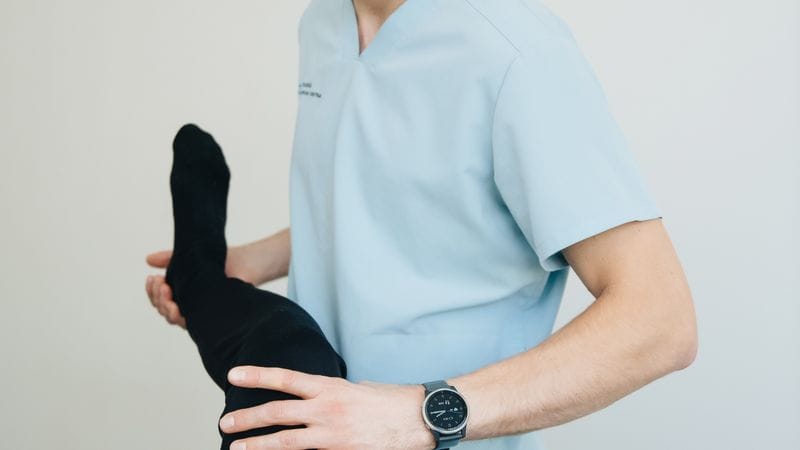
Patellar taping can be a useful short-term tool when pain blocks training tolerance, especially when combined with strength work. In one study from the supplied data, patellar taping with isometric strength training improved pain, strength, and functional performance over six weeks compared with placebo taping. Hasan, 2025
You now have the training structure. What you do not have yet is the recovery filter that tells you when to push, when to deload, and when to stop guessing.
Recovery, Lifestyle, and the Final Action Plan for Squat Knee Pain
Recovery supports knee pain during squats by raising tissue tolerance, reducing recovery debt, and helping your next training signal land cleanly instead of adding noise.
Nutrition, Sleep, Stress, and Body Management That Support Recovery
The supplied research set is mostly about biomechanics, strengthening, taping, neuromuscular control, and progression. It does not give strong direct evidence that one food or supplement fixes knee pain during squats. So the honest answer is simple: nutrition supports recovery, but it is not the main fix.
Knee pain during squats improves more reliably when recovery supports better loading decisions instead of trying to compensate for bad programming.
A practical recovery base looks like this: eat enough protein to support training adaptation, hydrate before lower-body sessions, keep sleep consistent, and avoid stacking hard leg sessions when the knee is already irritated. Recovery is not magic. It simply gives the tissues a better chance to tolerate the next signal.
Signal over noise. Always. If your sleep is poor, calories are low, stress is high, and every leg day becomes a test of pain tolerance, your knee is not failing. Your system is overloaded.
Recovery, Deloads, Red Flags, and When to Stop Pushing Through Pain
Use this distinction: trainable discomfort is mild, predictable, stable, and does not worsen the next day. Red-flag pain is sharp, increasing, swollen, unstable, traumatic, associated with locking, or changes how you walk.
| Trainable Pain | Red Flag | Action |
|---|---|---|
| Mild discomfort that stays stable | Pain increases set by set | Reduce depth, load, or stop the exercise |
| No next-day flare | Swelling or warmth | Seek clinical review |
| Pain improves after warm-up | Locking, giving way, or trauma | Stop self-experimenting |
The Complete 6- to 8-Week Knee Pain During Squats Action Plan
This plan is not a diagnosis. It is a return-to-squatting structure. Move forward only when symptoms stay stable for at least two sessions. If symptoms worsen, move back one phase.
| Week | Main Focus | Exercises | Progress Trigger |
|---|---|---|---|
| 1–2 | Calm symptoms | Box squat, Spanish squat hold, glute bridge | Pain stays low during and after training |
| 3–4 | Build capacity | Goblet squat to box, hip abduction, step-up | No next-day flare for two sessions |
| 5–6 | Increase range | Lower box squat, controlled split squat, tempo squat | Depth improves without sharp pain |
| 7–8 | Return to strength | Progressive squat loading, optional single-leg work | Technique stays clean under moderate load |
Squat Knee Pain Myths Debunked and Final CTA
Are squats bad for your knees?
No. Squats are not automatically bad for your knees. Poor load management, painful depth, poor control, and rushed progression are usually bigger problems.
Should your knees never go past your toes?
No. Knees can move past toes in many normal squat patterns. The better question is whether that position is controlled, tolerated, and appropriate for your current capacity.
Is knee valgus always dangerous?
No. Small movement is not always dangerous. Uncontrolled collapse under load, fatigue, or pain is the pattern worth correcting.
Should you stop squatting completely if your knee hurts?
Not always. You may only need to reduce depth, adjust stance, lower load, use a box, or temporarily switch to knee friendly leg exercises while symptoms calm down.
The lesson from that Monday squat is simple: the painful rep was not proof that squats were broken. It was proof that the system was overloaded. The fix was not fear. It was structure.
Final Takeaway
Knee pain during squats usually improves when you stop forcing painful depth and start rebuilding tolerance with better inputs. Use the The Wolfgymcore Neural-Mechanical Systems Method™ to control the signal: depth, load, hip support, quad capacity, recovery, then output. For the full base, return to the core systems approach. This week, test your pain-free squat depth, choose two support exercises, and progress only after two stable sessions.
About IBN EL KHATYB
Founder of wolfgymcore.com. Strength and systems specialist with two years of experience in fitness content, AI automation workflows, and server infrastructure. Applies the same input-output logic behind his AI client-acquisition systems to strength training programme design and biomechanics — because the body, like any well-built system, adapts to structure, not chaos.
Update Log
- June 27, 2026 — v1.0: Initial publication with squat biomechanics, knee-friendly exercise progressions, and 6- to 8-week action plan.
- June 27, 2026 — v1.1: Added GEO answer blocks, fixed image dimensions for CLS, and included four evidence-linked outbound sources.
Dynamic stat: Patellofemoral pain prevalence reported at 22.7% in the supplied research data.